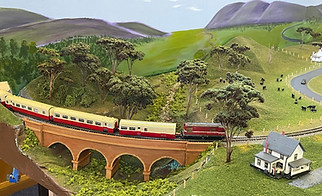
TT 120 Ng 3.5 (Narrow gauge 3"6")
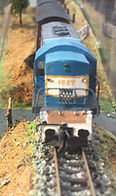_JPG.jpg)
So What is TT Scale?
TT is very much the forgotten scale in model trains in Australia. This is a great shame as it is very popular in Eastern Europe to a scale of 1:120 and now the UK Hornby Company has burst onto the scene with a comprehensive range of British prototype trains to this scale.
Also in the UK the 3mm Society has promoted TT 3mm to a slightly larger scale of 1:100. This has little advantage in space to HO/OO
So why model Australian 3ftr 6in Narrow gauge when nothing is available. Like all stories about the history of model trains, the answer is convoluted. The editor and his brother have lived in Qld and Tasamniaand wanted to model the trains they knew and decided to try scratch building
As you will see, the 1:120 scale allows the use of commercial components readily available in N scale and European TT models that can be adapted to make underframes and chassis for Australian N/G models. We also are not proposing fine-scale but work on the principle "If it looks right it is right" We don't want modellers to have a slavish adherence to exact scaling of every aspect of their model as this leads to frustration and giving up. This scale will be mostly a scratch builder's scale so let's have fun.
Rivet counters please pass over this site it's not for you.
Scale And Gauge
Narrow-Gauge Trains on 3'6" at 1:120 track gauge is close to 9 mm (8.8 mm to be precise)
This can use ordinary N gauge or the new Peco mainline 009 track which suits the Local protype well
Standard Gauge Trains on 4' 8 1/2 " at 1:120 track gauge is close to 12mm (11.95 to be precise)
This is available through both Peco and Tillig
Broad gauge Trains on 5'3" at 1:120 Track Gauge is 12.7. We suggest Tillig 12mm trackwork
We have chosen a quite unusual scale of 2.6 mm to the foot as a means of scaling the rolling stock
rather than strict 1:120 scale as it gives us a little more flexibility with the slightly
smaller Australian prototype, especially in the narrow gauge models.
The track gauge at this scale is just a fraction of a mm undersize in the Standard Gauge
and the Narrow gauge which is hardly noticeable.
Modelling on the broad gauge we suggest that using 12 mm track would still be appropriate
but you may then want to use the continental exact scale of 1:120
which gives a more accurate track gauge all be it still a tad undersize
Narrow gauge 3' 6"' in 2.6 mm to ft = 9.1 mm
Standard gauge 4' 8.5" in 2.6 mm to ft = 12.3 mm
Broad Gauge 5' 3" in 2.6 mm to ft = 13.6 mm
5' 3" in exact 1:120 scale =12.7 mm
As far as wheels standards go we have found that N gauge wheels and mechanisms work fine for the narrow gauge +2mm society wheels are an option.
European TT models are fine for the standard gauge, however, they are very expensive.
For steam, in standard gauge, it may be best to get wheels from the 3mm society in the Uk and handbuild the chassis.
Getting an exact match can be a little tricky.
But who knows, with 3D printing, we may be able to get special wheels and other bits done over time if there is enough interest
Standard Gauge Trains on 4' 8 1/2 " at 1:120 track gauge is close to 12mm (11.95 to be precise) This is available through both Peco and Tillig
Narrow-Gauge Trains on 3'6" at 1:120 track gauge is close to 9 mm (8.8 mm to be precise) This can use ordinary N gauge or the new Peco mainline 009 track